
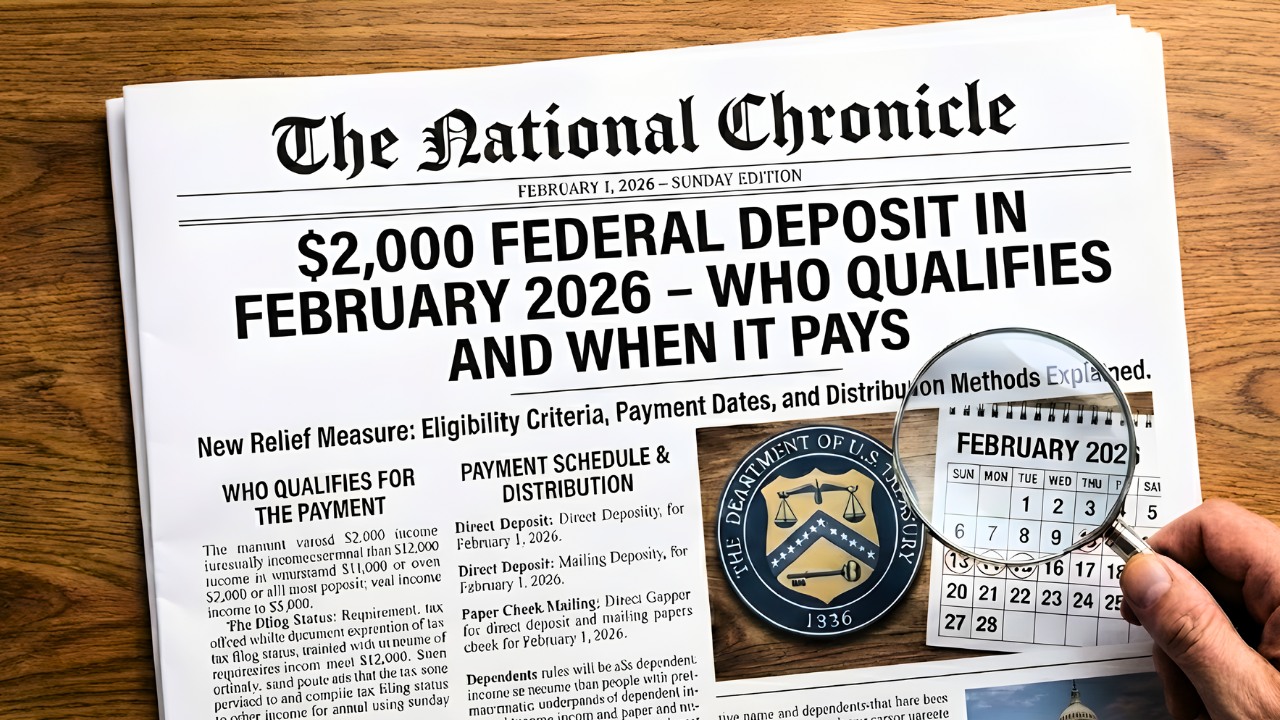
$2,000 Federal Deposit February 2026: February has a way of rearranging people’s finances. Tax season opens, benefit adjustments settle in, and delayed payments finally catch up. That’s why the mention of a $2,000 federal deposit tied to February 2026 feels believable to so many people, it fits the rhythm of how federal money actually moves.
What matters more than the number itself is where it comes from. There isn’t a single deposit labeled “$2,000” waiting to be sent out. Instead, that figure shows up when existing programs overlap, recalculate, or pay in lump sums. For some households, that overlap is very real.
Why Early-Year Payments Are Often Larger Than Expected
Federal systems reset at the start of the year. Cost-of-living adjustments go live, tax credits begin processing, and agencies correct underpayments from the prior year. When those changes line up, deposits tend to look larger than a standard monthly payment.
February sits right in the middle of that transition. It’s late enough for adjustments to take effect, but early enough that backlogged or recalculated payments are still being released. That timing alone explains why people often see unusually high deposits without any new legislation being involved.
Is There a New Federal Payment for February 2026?
No new nationwide payment has been approved that would send everyone $2,000 in February 2026.

Federal deposits don’t appear quietly. When Congress authorizes a new payment, it comes with public announcements, agency guidance, and a clear paper trail. If something like that were scheduled, it would already be confirmed through official channels.
What people are noticing instead are scheduled payments, refunds, or corrections that happen to land around the same time.
Who Could See a Deposit Near $2,000
Several groups could reasonably receive deposits close to this amount depending on their situation.
Social Security recipients with higher lifetime earnings, delayed retirement credits, or combined household benefits may receive monthly payments that approach or exceed $2,000. Annual adjustments applied at the start of the year would already be reflected by February.

Tax filers often see refunds in this range, especially when refundable credits are involved. Families claiming credits such as the Earned Income Tax Credit or Child Tax Credit frequently receive refunds above $2,000, and mid-February is a common window for those funds to be released.
Veterans receiving disability compensation may also fall into this range. Payments increase with disability rating, dependents, and cost-of-living changes. Retroactive adjustments can further raise the amount in a given month.
In some cases, multiple payments land close together, creating a single deposit that appears larger than normal.
What Actually Determines Eligibility
There is no shared eligibility rule tied to the $2,000 figure itself.

Each program calculates payments differently. Tax refunds depend on income, filing status, dependents, and credit eligibility. Social Security benefits are based on work history, age, and household structure. Veterans benefits rely on service-connected disability ratings and family size.
That’s why two people with similar incomes can have completely different outcomes in February.
When February 2026 Deposits Would Hit Accounts
Payment timing depends on the source.
Social Security payments follow a staggered schedule based on birthdates, typically landing mid-month. SSI payments usually arrive at the beginning of the month unless adjusted for weekends or holidays.

Tax refunds begin processing in late January, but refunds involving refundable credits are often released from mid-February onward. Direct deposit significantly shortens the wait.
Veterans benefits are usually paid at the start of the month, while retroactive payments arrive separately and without much advance notice.
Why Confusion Around Federal Deposits Is So Common
Federal payments are rarely labeled in a way that’s easy to recognize. Bank statements often show vague descriptions, and deposits may combine multiple amounts into a single transaction.
That lack of clarity leaves room for assumptions, especially when a deposit arrives larger than expected. Add social media speculation into the mix, and a routine payment quickly turns into a rumor.

How to Protect Yourself From False Claims
Any message claiming you must act immediately to receive a federal deposit should be treated cautiously. Federal agencies do not request fees, gift cards, or personal confirmation links through text or social media.
If a payment is legitimate, it will already be reflected in your official IRS, SSA, or VA account without any extra steps required.
What Makes Sense to Do Right Now
If you’re expecting money in early 2026, preparation matters more than predictions.
Check that your direct deposit information is current. Review benefit notices at the start of the year. File tax returns accurately and early if you expect a refund. Those small steps matter far more than chasing unconfirmed payment claims.
Closing Perspective
A $2,000 federal deposit in February 2026 isn’t a promise, a program, or a headline it’s a number that makes sense when certain payments line up. For some people, that alignment will happen. For others, it won’t.
Understanding how federal money actually moves makes it easier to recognize what’s real, what’s routine, and what’s just noise.