
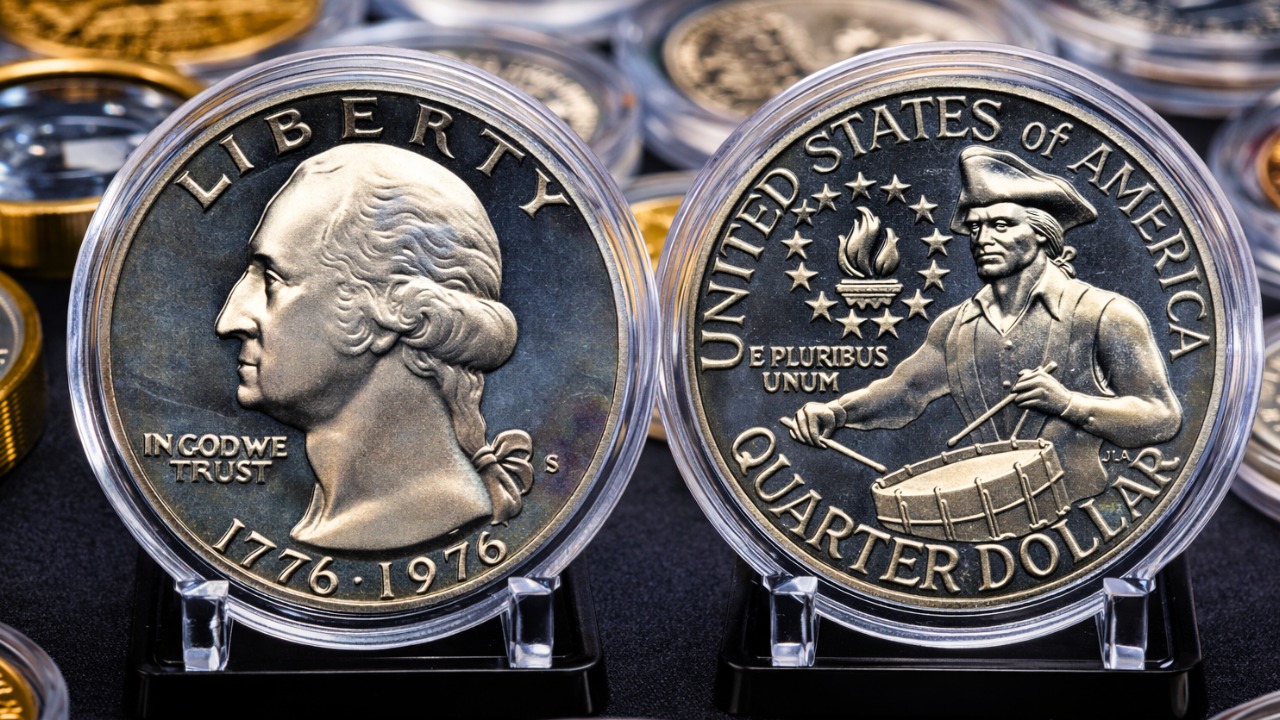
1976 Drummer Boy Quarter: Every so often, a story ripples through the coin-collecting world that makes even casual collectors stop and check their change jars. The 1976 Drummer Boy Quarter is one of those stories. While most of these quarters are worth little more than face value, a handful of rare examples have reportedly sold for eye-popping sums up to $550,000 in extreme cases. That possibility has sparked renewed interest, sending collectors and everyday Americans alike scrambling to see if they might be sitting on a small fortune.
The Drummer Boy Quarter doesn’t look particularly special. Millions were minted, and it circulated widely. But as with many collectibles, the real value lies in the details, the condition, and the rare mistakes that slipped past the U.S. Mint decades ago.
The Story Behind the 1976 Drummer Boy Quarter
The Drummer Boy Quarter was released as part of the United States Bicentennial coinage, celebrating 200 years of American independence. Instead of the traditional eagle on the reverse side, the coin features a colonial drummer with a torch encircled by 13 stars, representing the original colonies.
The obverse still displays George Washington’s portrait, but with a twist: the date reads “1776–1976” rather than a single year. This dual date instantly sets the coin apart from standard Washington quarters and makes it a nostalgic symbol of America’s bicentennial celebration.
Because these quarters were produced in massive quantities over 1.6 billion across all mints most people assume they are common. And generally, they are. However, rarity in coin collecting is not always about age or how many were minted; it’s about anomalies and preservation.

Why Some Drummer Boy Quarters Are Worth a Fortune
The staggering $550,000 figure isn’t attached to just any 1976 quarter. That kind of value applies to exceptionally rare specimens with specific characteristics that make them nearly one of a kind.
One major factor is minting errors. Coins struck with dramatic errors such as doubled dies, off-metal strikes, or missing layers are highly sought after. A severe doubled die on the obverse or reverse can dramatically increase a coin’s value, especially if the doubling is clearly visible to the naked eye.
Another factor is composition. While most Bicentennial quarters were made of copper-nickel clad, a limited number were struck in 40% silver for collector sets. Even rarer are coins accidentally struck on the wrong planchet, such as a silver planchet intended for another denomination.
Finally, condition plays a critical role. Coins graded at the highest levels, such as MS-68 or MS-69 by professional grading services are extraordinarily rare. When you combine pristine condition with a significant mint error, the result can be a coin worthy of a six-figure auction price.

Mint Marks and What They Mean
To understand whether a Drummer Boy Quarter might be special, collectors first look at the mint mark. These quarters were produced at three locations: Philadelphia (no mint mark), Denver (D), and San Francisco (S).
Philadelphia and Denver minted coins primarily for circulation, while San Francisco produced both proof coins and silver collector versions. Proof coins typically have mirror-like finishes and sharper details, making them more desirable to collectors.
However, the highest values tend to come from unexpected combinations such as a circulation coin with proof-like qualities or a mint error on a San Francisco proof. These anomalies are rare, but they are the reason collectors pay such close attention.
The Role of Professional Grading
No coin reaches a six-figure valuation without professional verification. Third-party grading services like PCGS and NGC authenticate coins, identify errors, and assign a grade based on condition.

A difference of even one grade point can translate into thousands or tens of thousands of dollars. For example, a Bicentennial quarter graded MS-65 might be worth a few hundred dollars if it has a notable error, while the same coin in MS-68 condition could be worth exponentially more.
Collectors are advised never to clean or polish a coin before submission. Cleaning can permanently damage the surface and drastically reduce value, even if the coin is otherwise rare.
How to Tell If Yours Might Be Valuable
If you have a 1976 Drummer Boy Quarter, start by examining it closely under good lighting. Look for doubling in the lettering or date, unusual textures, or signs that the coin may be off-center or struck on the wrong metal.
Weighing the coin can also provide clues. A standard clad quarter weighs about 5.67 grams, while silver versions weigh slightly more. Any significant deviation could indicate an error.

That said, visual inspection can only go so far. If something seems unusual, the next step is to consult a reputable coin dealer or submit the coin for professional grading.
Why Collectors Are on High Alert Right Now
Recent auction results and viral headlines have reignited interest in Bicentennial coinage. As more collectors enter the market and competition increases, rare examples are fetching record prices.
Social media and online marketplaces have also amplified awareness. Stories of ordinary people discovering valuable coins in inherited collections or old jars fuel excitement and curiosity, encouraging others to take a closer look at their own change.
Additionally, as time passes, truly pristine examples become even harder to find. Coins that survived decades of circulation without damage are increasingly scarce, pushing values higher.

A Reminder About Realistic Expectations
While the idea of a $550,000 quarter is thrilling, it’s important to keep expectations grounded. The vast majority of 1976 Drummer Boy Quarters are worth between 25 cents and a few dollars. Only a microscopic fraction qualifies for life-changing valuations.
Still, that doesn’t make the search pointless. Coin collecting is as much about history and discovery as it is about money. And every so often, someone does find that extraordinary piece hiding in plain sight.
Final Thoughts
The 1976 Drummer Boy Quarter is a powerful reminder that hidden treasures can exist in the most ordinary places. While most are common, a select few have become legends in the numismatic world, commanding prices that seem almost unbelievable.
Whether you’re a seasoned collector or someone casually checking your spare change, the story behind this coin adds a layer of excitement to an everyday object. And who knows? That unassuming quarter in your drawer might just be worth a second look.